Introduction
Choose a rigid box when a substantial structure and presentation experience justify its production, storage, and shipping requirements. Choose a folding carton when a printable retail enclosure and efficient flat storage better fit the product. Neither construction automatically replaces a tested shipping package.
For overseas sourcing, the useful question is not simply which box looks more premium. It is which complete packaging system fits your product, order quantity, packing operation, distribution route, and commercial objective.
A presentation box that arrives assembled may occupy considerable warehouse space. A carton delivered flat may need folding, loading, closing, and checking at your facility. Either option can become expensive if its dimensions, insert, or assembly method are poorly matched to the product.
This guide explains the structural differences, the questions that change a quotation, and the sample checks buyers should consider. Use the illustrative buying scenarios to identify the information your supplier needs. Specific box constructions, materials, testing, and manufacturing arrangements must be confirmed for your enquiry.
What is a rigid box?
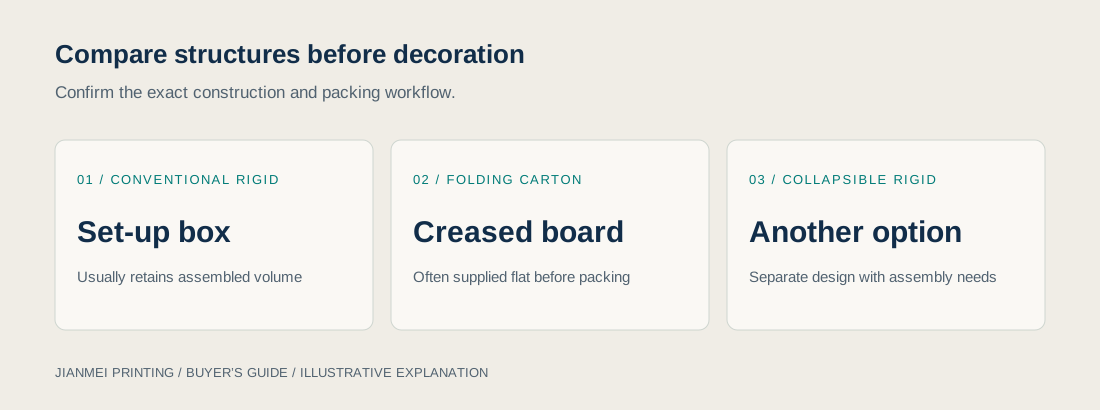
A conventional rigid box uses a substantial board structure, often covered with a separate printed or decorative wrap. Common designs include a separate lid and base or a hinged presentation format. The structure generally retains its shape rather than being flattened during ordinary storage.
Rigid construction can support a controlled opening experience and a structured product presentation. It may suit gift sets, keepsake products, or other items where the box forms part of the customer experience. Suitability still depends on the product and the economics of the complete order.
Collapsible rigid boxes are a separate option. They can reduce storage volume compared with conventional assembled rigid boxes, but they introduce their own assembly, closure, and structural details. “Folding rigid box” should not be treated as another name for a standard folding carton.
What is a folding carton?
A folding carton is cut and creased from paperboard, often with a glued seam, and formed into shape during packing. Its structure can provide printable panels, product identification, and a retail enclosure. Many designs are delivered flat before use.
Carton performance depends on the board grade, grain direction, dimensions, crease design, closure, and product load. A folding carton is not necessarily corrugated. Corrugated board contains a fluted layer and represents another structural family used widely for transport and other applications.
Packhelp distinguishes rigid boxes from folding cartons and positions the latter for lighter, high-volume retail packaging. That is a useful initial distinction, but your actual product and packing system should determine the specification. Source: Packhelp rigid-box guidance.
Compare the two constructions as a complete system
| Buying consideration | Conventional rigid box | Folding carton |
|---|---|---|
| Basic structure | Substantial board, often separately wrapped | Cut and creased paperboard |
| Empty storage | Usually retains assembled volume | Often supplied flat |
| Presentation role | Structured opening and product display | Retail enclosure and printed information |
| Operating requirement | Check loading, insert, and closure | Check erection, loading, and closing |
| Cost drivers | Board, wrapping, assembly, inserts, and volume | Board, tooling, printing, gluing, and erection |
| Transport protection | Validate with the complete shipping system | Validate with the complete shipping system |
| Useful sample | Actual structure, wrap, insert, and product | Actual board, crease, closure, and product |
The table identifies questions rather than fixed performance rankings. A carefully developed folding carton can suit its intended load better than an oversized rigid box with an ineffective insert. An attractive surface finish does not compensate for poor product retention.
Start with product application and sales channel
Gift sets and presentation-led products
A gift set may need several components arranged in a particular order. Define what the recipient sees first, how items are removed, and whether the box should be retained. A rigid construction can support this experience when the commercial value justifies it.
Test removal as well as retention. An insert that grips too tightly can frustrate users or damage a delicate surface. An insert that fits only the nominal product dimensions may fail when normal manufacturing variation is included.
Routine retail replenishment
A retail carton may need barcode readability, consistent shelf appearance, clear opening instructions, and rapid replenishment. The packing team’s workflow matters: how flat cartons are stored, how they are erected, and how reliably closures remain shut after loading.
If packing is automated, share the equipment and line requirements before structural development. A shape that works during hand assembly may not suit the intended line. Obtain approval from the team that will actually run the packaging.
E-commerce and mixed distribution
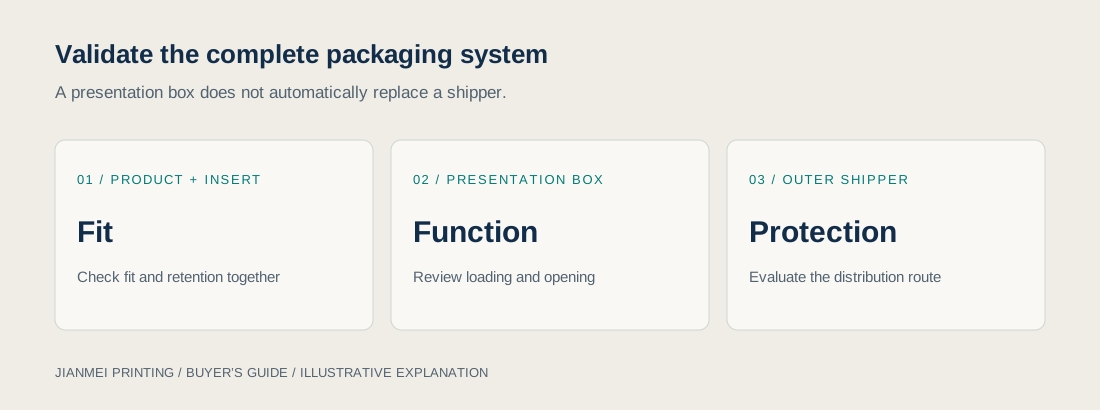
Direct-to-consumer parcels may pass through repeated handling and sorting. A presentation box can sit inside a separate protective shipper with suitable cushioning or retention. Evaluate the whole combination rather than declaring the decorative box “shipping ready” because it feels firm.
For mixed distribution, explain every route: factory to warehouse, warehouse to store, or warehouse to individual customer. The same retail box may need different outer packing for palletized deliveries and single-parcel fulfillment.
Specify dimensions and materials without ambiguity
Distinguish internal and external measurements
State the measurement order and whether dimensions are internal or external. Provide product drawings or physical samples, including caps, handles, protective films, accessories, and other protrusions. A rectangular estimate that ignores these details can produce an unusable insert.
Clearance should account for loading, removal, product variation, and any wrapping. Do not select an arbitrary gap from a photograph. Ask the packaging developer to propose and explain the allowance, then verify it with a physical fit sample.
Specify board properties beyond gsm
Grammage measures mass per area; thickness and stiffness are separate properties. A carton’s structure cannot be defined by “350 gsm” alone. Request the board grade, thickness information, and proposed construction, especially if comparing suppliers using different material systems.
For a wrapped rigid box, distinguish the structural board from the outer wrap and liner. Ask how corners, joints, and exposed edges will be formed. An exterior photograph may conceal details that affect appearance, assembly quality, and usable internal space.
Include the insert and closure
List the insert material, number of components, orientation, retention function, and assembly method. Define whether a closure uses tabs, friction, adhesive, magnets, or another mechanism. Each choice changes the bill of materials and the sample review.
Where magnets, plastic windows, or mixed-material inserts are proposed, evaluate whether they are necessary. They may add function, but they can also complicate disassembly and end-of-life handling. Ask for a simpler alternative if it can meet the same customer requirement.
Compare total cost rather than unit price alone
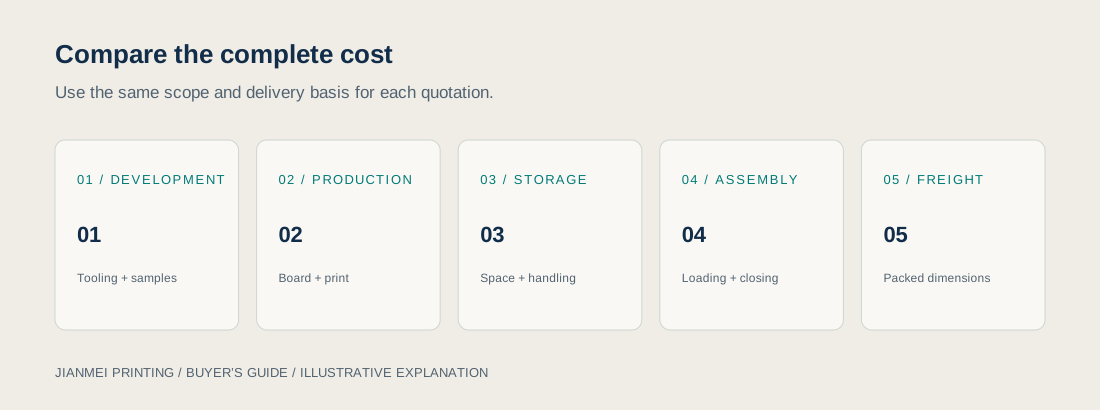
A useful comparison includes development and tooling, samples, production, inserts, packing, freight, storage, local assembly, and any relevant duties or taxes. Confirm the delivery basis and which costs are included. An ex-factory price and a delivered price are not directly comparable.
Separate costs that occur once from costs that repeat on each order. Ask whether the quotation assumes one design or multiple versions, one delivery or several releases, and whether existing tooling can be reused after a change. Avoid assuming that a previous tool remains suitable for a revised product.
An illustrative storage-volume calculation
Suppose an assembled empty box has external dimensions of 200 × 150 × 60 mm. Its bounding volume is 0.0018 cubic meters. Across 1,000 boxes, that represents 1.8 cubic meters before master cartons, gaps, protection, or pallet inefficiency.
This is a geometric example, not a freight quotation or a rigid-box industry average. Flat cartons may occupy less empty-pack volume, but the actual comparison requires packed dimensions and quantities. Carrier billing may depend on service-specific dimensional-weight rules, gross weight, or other shipment characteristics.
Prepare structural artwork before decorative details
Request a production-approved dieline for the selected structure. It should distinguish cutting, creasing, glue areas, bleed, and safe zones. Confirm panel orientation by folding a labeled dummy before finalizing artwork. A flat layout can make the eventual top, bottom, and opening direction easy to misunderstand.
Keep essential text, barcodes, and product identification clear of folds, glue seams, and areas hidden after assembly. If a barcode is commercially important, verify the final printed symbol with an appropriate method and against the receiving partner’s requirements. A readable code on a screen does not establish print performance.
Define foil, embossing, spot effects, and windows as separate production features. Confirm registration expectations and minimum features with the manufacturer. On a wrapped structure, allow for how artwork moves around corners and how wrap edges finish inside the box.
Prepare folding instructions, loading order, insert placement, and closure steps for the team that will pack the product. A short assembly video can help a remote team review the intended process.
Use samples to verify fit, function, and appearance
Begin with a structural sample
A blank structural sample is useful before investing in decorative finishing. Load the real product or a representative substitute with the same relevant dimensions and mass. Check fit, removal, closure, and whether components can move into damaging contact.
A substitute should reproduce the characteristics important to the decision. A lightweight foam block may demonstrate size but not the behavior of a heavy glass item. Record any difference and avoid using that sample to approve protection it cannot meaningfully assess.
Review printed and finished samples
Inspect color, wrap alignment, visible adhesive, corners, surface marking, and opening behavior. For a carton, inspect fold cracking, flap alignment, glue integrity, and loaded closure. For a rigid box, review lid fit, hinge action where present, and insert positioning.
Ask which materials and processes match production. A handmade sample can establish a design direction without proving the consistency of the intended manufacturing process. Identify unresolved points and approve them explicitly before the bulk order proceeds.
Retain an approved reference
Keep a dated approved sample linked to the specification and artwork version. Record critical dimensions, acceptable visual variation, and any approved exceptions. A video discussion is useful, but it should not be the only record of an important production decision.
Define factory testing and transport evaluation separately
Factory checks can address dimensions, assembly, print appearance, closures, and quantity. Transport evaluation addresses the product and package together under relevant distribution hazards. A decorative box inspection does not demonstrate protection through an overseas and last-mile route.
ISTA advises understanding the actual distribution environment when selecting a test procedure. If formal transport testing is required, agree the procedure, packed configuration, laboratory arrangements, sample quantity, and acceptance criteria with a competent provider. Source: ISTA design and testing guidance.
Do not replace that process with an unrecorded drop demonstration. A test result belongs to the specific configuration evaluated. Changes to product mass, inserts, outer cartons, or packing can change performance. Ask whether a change requires a fresh review or additional testing.
JianMei’s capability to perform or arrange a particular test must be confirmed for the project. Do not interpret a general discussion of factory testing as a certificate, a completed report, or a guarantee of damage-free delivery.
Agree shipment inspection and receiving requirements
Before production, define what shipment inspection must verify: approved design, material conformity, dimensions, appearance, assembly, quantity, and packing. State the sampling method and defect categories where they are part of the contract. “Inspect before shipping” is not a complete inspection plan.
Confirm how flat cartons or assembled boxes will be counted and protected. Include master-carton dimensions, gross weight, marks, orientation, and any pallet requirements. Avoid making cartons so heavy or awkward that the receiving team cannot handle them safely and consistently.
Request packing photographs that show the configuration, not only a closed carton. At arrival, record carton condition and compare goods with the retained sample. Establish a clear route for reporting discrepancies, including photographs, quantities affected, and batch or carton references.
Discuss environmental claims with specific evidence
Neither rigid boxes nor folding cartons are automatically sustainable. Material sourcing, total mass, finishing, mixed components, reuse, and the destination’s collection system all matter. A paper-based appearance does not establish recyclability of the complete finished package.
If recycled content, certified sourcing, or another claim matters, request evidence for the exact material and supply arrangement. Do not add certification logos without authorization. Prefer a precise, supportable description over broad claims such as “100% eco-friendly.”
Control changes after product development
Recheck the packaging whenever the product changes size, weight, surface finish, or accessories. A new bottle cap or additional cable can affect fit and retention even if the outer box remains unchanged. Keep a revision record linking the product, insert, dieline, artwork, and outer packing. This allows a repeat order to reproduce an approved system rather than a mixture of old and new components.
FAQ
Are rigid boxes always stronger than folding cartons?
They usually use a more substantial structure, but suitability depends on geometry, materials, inserts, product load, and distribution. Compare complete packages against your requirements rather than treating box type as a universal strength rating.
Can folding cartons look premium?
Yes. Material, structural design, print quality, and carefully chosen finishing can create a refined result. Review an assembled physical sample because appearance alone does not establish fit, closure, or handling performance.
Can a rigid box be shipped flat?
Conventional set-up rigid boxes usually retain their shape. Collapsible rigid designs are available as a separate construction. Confirm their assembly method, closure, strength, packed dimensions, and suitability for your product.
Can I use a presentation box as the shipping box?
Only if the complete product and package configuration has been developed and validated for the intended route. Many presentation boxes need a separate shipper and protective components. Do not assume rigidity alone provides parcel protection.
Which option has a lower minimum order quantity?
MOQ varies with materials, tooling, printing, finishing, and production arrangements. Request a project-specific answer. A low quantity offered for one supplier’s standard box does not establish the MOQ for a fully custom design.
What information is needed for an accurate quotation?
Provide product dimensions and weight, component list, intended use, quantity, preferred structure, artwork, finish, insert requirements, packing location, destination, and arrival target. Mark unknown items so they can be resolved before approval.
Conclusion
Rigid boxes and folding cartons solve different presentation and operating problems. The better choice fits the product, packing process, customer experience, and delivery route at an acceptable total cost.
Begin with a clear brief, approve the structure before decorative details, and validate the complete packing system. That process makes supplier proposals easier to compare and gives your receiving team a practical standard for inspection.