Introduction
Choose Wire-O when paired metal loops and a coordinated presentation suit your notebook. Consider plastic spiral coil when flexibility during handling is a priority. Both can open flat and fold back, but the right choice depends on the complete book block, cover, artwork, packing, and intended use.
For an overseas buyer, the decision reaches beyond the binding visible in a product photograph. A notebook must feel comfortable during writing, turn pages without catching, survive its distribution route, and arrive in the quantity and condition your sales or training program requires.
A specification that says “A5 spiral notebook, 160 pages” leaves several purchasing questions unresolved. Does spiral mean a continuous plastic coil or twin-loop wire? Are those 160 printed pages or 160 sheets? Is the cover flexible card or wrapped board? What will protect the binding inside the export carton?
This guide explains the differences and provides a practical route from product application to sample approval. Use the planning scenarios to prepare your own specification and sample checks. Availability, minimum order quantity, and production arrangements require confirmation against your actual brief.
What is the difference between Wire-O and spiral binding?
Wire-O uses paired metal loops
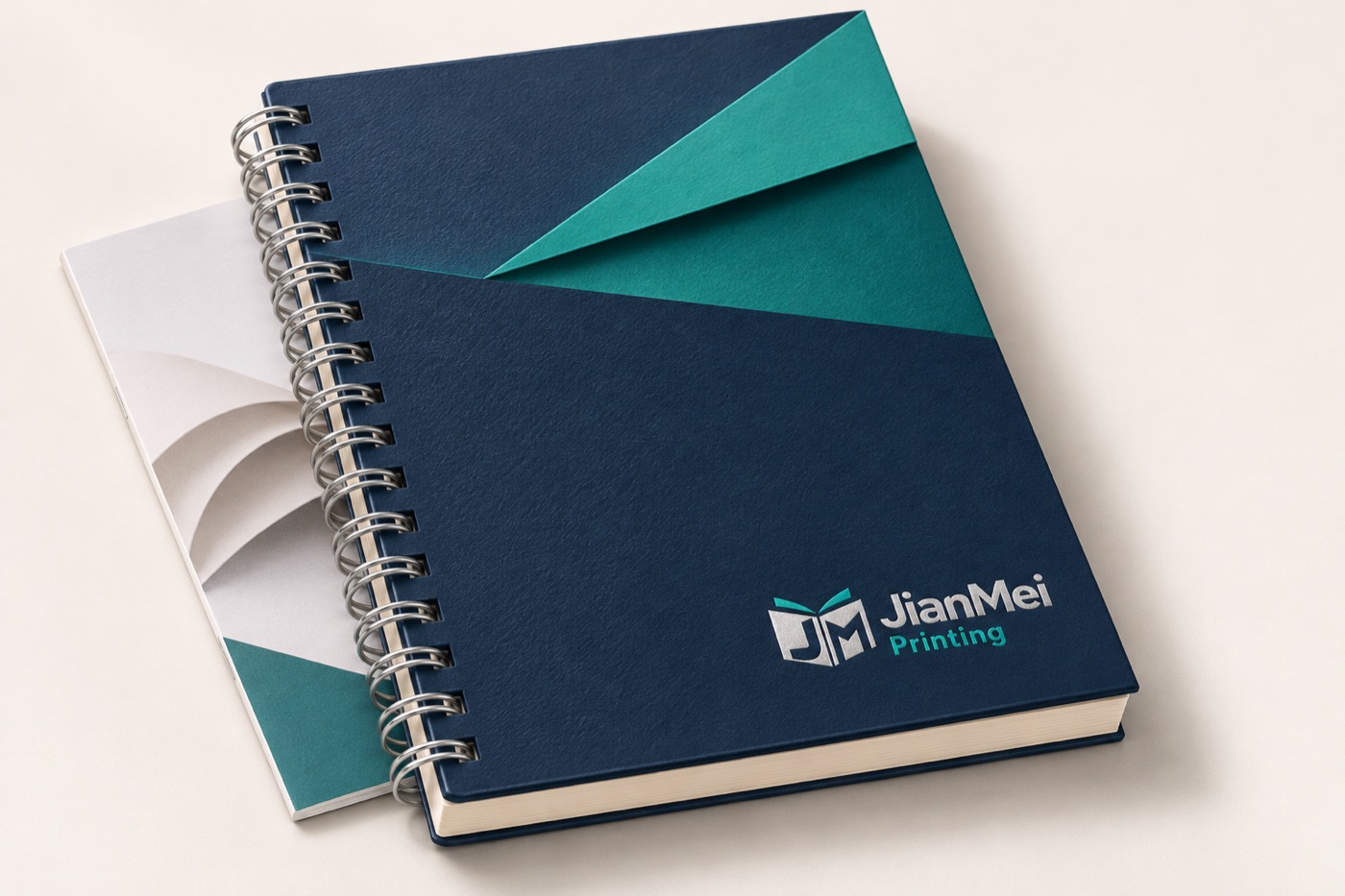
Wire-O, also called twin-loop or double-loop wire binding, passes a formed wire element through punched holes. The open element is closed around the assembled pages and covers. Its repeated pairs of loops give the spine a distinctive appearance.
A correctly specified and closed binding allows pages to move around the spine. It is useful for notebooks, planners, workbooks, and other products that people consult while writing. The finished result depends on hole placement, wire size, closing accuracy, and the combined thickness of all components.
Spiral binding uses one continuous coil
Spiral binding threads a continuous coil through the punched book block. The coil may be plastic or metal, so a quotation should identify the material rather than use “spiral” alone. Plastic coil is the comparison used throughout this guide unless stated otherwise.
Both constructions can support flat opening and fold-back use. Their appearance, response to compression, and finishing process differ. Neither name alone establishes a universal durability rating or a guaranteed maximum page count.
Wire-O vs plastic spiral coil at a glance
| Buying consideration | Wire-O | Plastic spiral coil |
|---|---|---|
| Visible structure | Paired metal loops | One continuous plastic coil |
| Writing and reference use | Flat opening and fold-back possible | Flat opening and fold-back possible |
| Handling concern | Loops can deform under pressure | Flexibility varies with material and diameter |
| Presentation | Regular double-loop pattern | Continuous spiral appearance |
| Capacity decision | Measured book-block thickness and available wire | Measured book-block thickness and available coil |
| Quality checkpoint | Closing consistency and unobstructed page movement | Coil insertion, end finishing, and page movement |
| Freight decision | Protect exposed binding against crushing | Validate packing and end protection |
Do not select from this table alone. Ask for a representative bound sample with the paper, covers, dividers, and accessories proposed for the order. A sample with thin substitute paper may give a misleading impression of page movement and overall thickness.
Start with the notebook’s actual use
Corporate gifts and branded stationery
For a corporate notebook, the binding is part of a wider presentation: cover texture, print alignment, corners, paper shade, and any foil detail. Wire-O can suit a design that uses a deliberate metallic accent. Confirm the available wire color from a physical sample because screen colors cannot reliably represent reflective metal.
Evaluate writing comfort as well as appearance. A thick cover, large binding element, or narrow writing area can interfere with a user’s hand. Ask someone unfamiliar with the design to write on both sides of the spread, including near the binding edge.
Training workbooks and practical manuals
A workbook may stay open on a crowded desk while the reader completes exercises. Flat opening, clear page numbering, and space for handwritten answers become more valuable than an elaborate finish. Plastic coil deserves consideration where flexibility during frequent handling matters, but a sample is still necessary.
If staff carry the workbook between locations, include that behavior in the brief. A classroom manual, workshop reference, and desk planner face different handling conditions. The phrase “heavy duty” is less useful than a description of how people will carry, store, and open the product.
Retail planners with tabs and inserts
Dividers, pockets, and thicker planning pages change the assembled thickness. Protruding tabs also affect trim dimensions and packing. Confirm whether tabs must remain within the cover outline or extend beyond it, and verify that pages can turn past them without catching.
If the product must show a printed title on a conventional spine, review another construction. Standard exposed Wire-O and coil binding do not provide the same printable spine panel as a conventional bound book. A concealed-wire design is a separate construction requiring its own development.
Explore custom Wire-O notebooks when preparing a project brief.
Specify pages, paper, and binding as one system
Count pages and sheets correctly
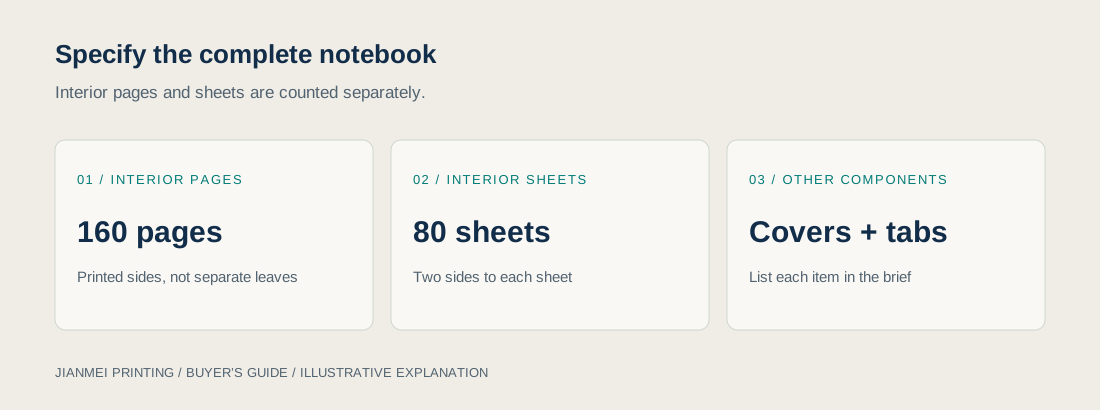
A sheet has two sides. A notebook with 160 interior pages normally contains 80 interior sheets when each side counts as one page. Covers, dividers, pockets, and end components should be listed separately. Include a simple component list in the request for quotation.
Page count alone does not determine binding size. Two papers with the same grammage can have different thicknesses. Coatings, bulk, and manufacturing characteristics affect the book block. The production team should select the binding against the measured assembled thickness rather than an assumed page-count rule.
Separate grammage from writing performance
Grammage, expressed in grams per square meter or gsm, describes mass per area. It does not guarantee opacity, smoothness, or resistance to ink penetration. A planning brief might compare 80, 100, and 120 gsm uncoated papers, but those are sample candidates rather than promised stock options.
Test the pens your audience will use. Ballpoint, rollerball, gel, and fountain pens can behave differently on the same sheet. Look for feathering, show-through, drying behavior, and ink transfer when pages close. Record the pen type and paper identity so the result is reproducible.
Confirm pitch and hole layout
Wire pitch describes hole frequency. GBC identifies common wire patterns as 3:1 and 2:1, meaning three or two holes per inch. The punch pattern must match the selected wire. These are compatibility details, not interchangeable decorative choices. Source: GBC binding types.
Ask the supplier for a template showing the punch zone, trim line, and safe area. Important text, ruled columns, page numbers, and logos should remain clear of the holes. A generic bleed setting does not provide binding clearance.
Prepare artwork around the binding edge
Use the printer’s approved template before completing the design. Confirm finished dimensions, bleed, safe areas, hole position, cover overhang, and whether covers require separate files. A design prepared for perfect binding should not be transferred to Wire-O without checking the inner margins.
Keep continuous photographs and critical diagrams away from the punched edge. Even if adjacent pages appear aligned, holes and the exposed binding interrupt the image. A chart that works across a screen spread may become difficult to read when printed and punched.
Ask whether the factory requires single pages, a particular PDF standard, embedded fonts, and a specific color workflow. Do not impose a color profile simply because it appeared in another printer’s instructions. The approved workflow should fit the press condition and chosen paper.
Control revisions carefully. Give each approved file a version identifier, confirm whether blank pages are intentional, and identify which sample corresponds to the final artwork. Production should not proceed with an older cover file paired with a newly revised interior.
Approve the right sample before bulk production
Understand what each sample demonstrates
A blank dummy helps assess dimensions, thickness, cover construction, and page movement. A digital printed sample may help review layout and sequence, but it may not reproduce the final offset color or finishing. A production-method sample can answer more questions, with different costs and scheduling implications.
Ask which components and processes match the intended order and which are substitutes. Record those differences. If the sample uses a different paper or temporary wire color, approval should specify exactly what remains open rather than treating the entire product as approved.
Use a repeatable sample review
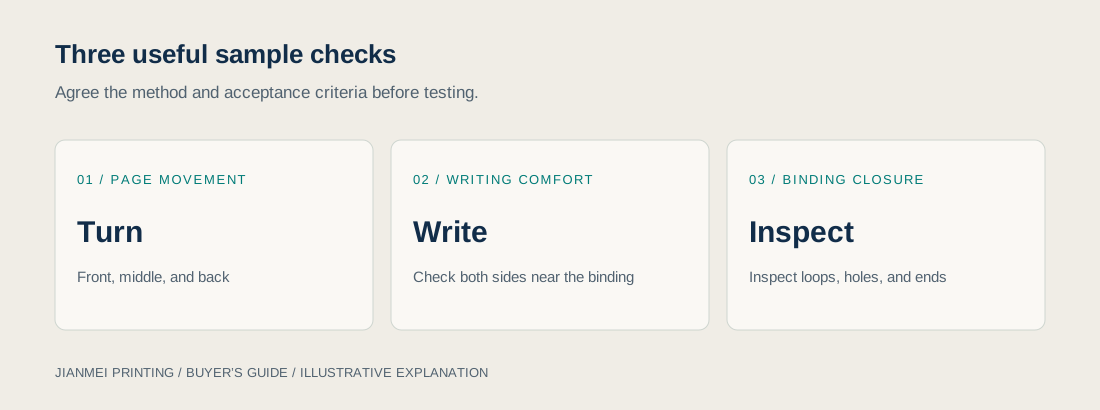
Open the sample at the front, middle, and back. Turn individual pages and several pages together. Check for catching, torn holes, uneven closing, exposed sharp ends, or pages escaping the binding. Then write on both sides and inspect the cover for rubbing or cracking.
These are proposed factory testing and buyer review checks, not a claim that a particular batch has passed them. If repeated-opening performance matters, agree the number of cycles, handling method, and acceptance criteria before testing. “Opened several times” is not a meaningful durability specification.
Plan shipment inspection around the exposed spine
A notebook can leave assembly in good condition and become damaged through pressure during packing or transport. GBC specifically warns that stiff wire can bend when wire-bound documents are mailed in envelopes. The purchasing implication is to review protection around the spine, not simply the appearance of the outer carton. Source: GBC wire-binding guidance.
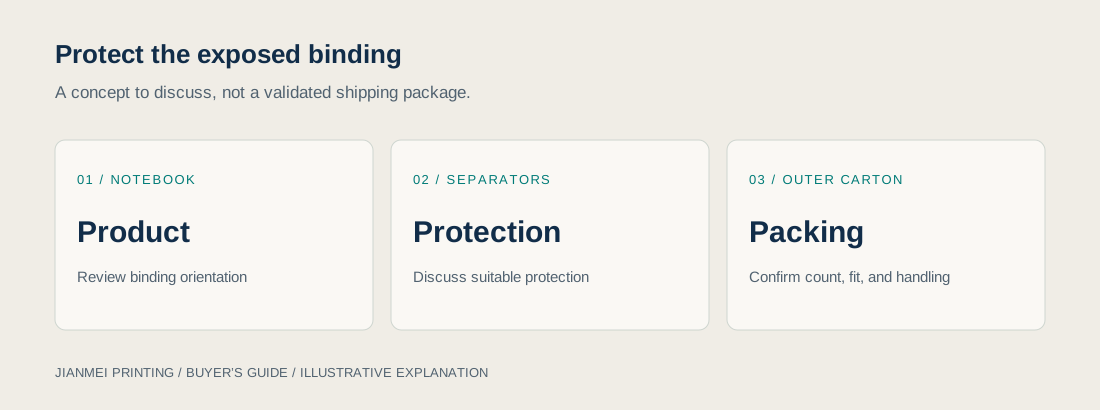
Discuss orientation, units per bundle, separators, carton fill, and any individual protection. Avoid assuming shrink film prevents crushing: it can hold items together without providing a protective structure. Ask for photographs showing the packing sequence and the relationship between the binding and the carton wall.
A shipment inspection plan should identify checks for quantity, artwork version, page sequence, binding function, visible damage, and packing conformity. Define how samples are selected and how defects are recorded. A few attractive photographs are useful communication, but they do not establish the quality of an entire shipment.
Before dispatch, confirm carton dimensions, gross weight, carton count, shipping marks, and the agreed delivery arrangement. A receiving team should know what to inspect on arrival and how to retain evidence if cartons show compression or moisture exposure.
Compare quotations without hiding the tradeoffs
Binding price depends on quantity, materials, dimensions, finishing, assembly, and packing. There is no dependable universal rule that one construction is always cheaper. Compare quotations against an identical component list and ask suppliers to identify any proposed substitutions.
Separate one-time development charges, samples, production, packing, and freight. Confirm whether the price includes dividers, pockets, individual wrapping, or delivery to the final address. A lower unit price can be offset by additional assembly or damage exposure elsewhere in the buying process.
An illustrative purchasing brief
Suppose a distributor needs an A5 training notebook with 160 interior pages and four tab dividers. The sensible next step is to build the complete block, compare the available binding options, and review writing comfort. Choosing wire diameter from “160 pages” alone overlooks the dividers and actual paper caliper.
The same brief should state whether notebooks go directly to trainees or first enter a warehouse. That distinction changes packing and labeling requirements. This example illustrates the decision process; it does not establish JianMei stock availability, pricing, or delivery performance.
Make the approval record usable by production
Keep one approved specification that combines the final artwork references, measured sample details, component list, and packing instructions. Add dated comments for any accepted variation. If a buyer approves cover appearance by email and page movement on a separate video call, consolidate those decisions before releasing production. A clear approval record reduces misunderstandings when purchasing, design, and production teams work across time zones.
Keep specification changes visible
When the design changes, ask which other parts of the specification must change with it. Adding a pocket may require a different binding diameter, while moving a tab can affect the cover outline and packing. A change to the interior paper can alter writing performance as well as thickness. Have the supplier identify those consequences before approving the revised quotation.
For repeat orders, retain a physical reference and the component list from the approved version. Confirm material identity and availability again rather than assuming that a matching product name guarantees an identical construction. If consistency between batches matters to your retail program, identify the characteristics you need to compare and the evidence required before release. This gives purchasing and quality teams a shared basis for reviewing the next order.
FAQ
Is Wire-O the same as spiral binding?
No. Wire-O uses paired metal loops, while spiral binding uses one continuous coil. Some sellers use “spiral” loosely, so specify the construction and material and include a reference photograph with your enquiry.
Do both bindings open flat?
Both can open flat and fold back when correctly specified and manufactured. Paper stiffness, cover construction, binding size, and assembly quality affect the experience. Check a representative sample rather than relying on the binding name.
Which binding is more durable?
There is no single answer for every application. Metal wire can deform under compression; plastic coil performance depends on its material and geometry. Compare samples against the handling and transport conditions relevant to your notebook.
How many pages can a Wire-O notebook have?
Capacity depends on measured block thickness, paper caliper, covers, inserts, available wire, and equipment. Ask the supplier to confirm capacity for the complete construction. A published page limit for one paper should not be transferred automatically to another.
Can pages be added after binding?
Standard Wire-O and spiral notebooks are not designed for routine page replacement. Removing and rebinding components may damage them. If users need frequent updates, discuss a purpose-designed refillable construction instead.
What should I send to request a quotation?
Provide intended use, finished size, page and sheet count, quantity, paper preference, cover construction, interior printing, dividers, packing, destination, and required arrival date. Identify unknown details so the supplier can propose options for review.
Conclusion
The most reliable binding choice starts with how the notebook will be used and ends with an approved physical construction. Wire-O and plastic coil can both serve practical writing products. Their suitability becomes clear when paper, covers, page movement, artwork clearance, and shipment protection are evaluated together.
Use a complete specification and documented sample review to make supplier quotations comparable. That approach gives purchasing teams a stronger basis for approval than appearance, a generic durability claim, or a page-count limit taken out of context.